





Skip to content

Short courses and accredited English proficiency

A great way to build one skill area or start a pathway to a job or further study. A single unit or skill set can count towards a formal qualification.

Teacher at a whiteboard leading a class of adult students

General English by level

Start at the level that suits you, from beginner to upper-intermediate. A placement test at enrolment confirms your level.

  • Teacher pointing at words on a whiteboard while adult learners take notes

    Beginner Level English

    For learners starting their English journey. It focuses on basic vocabulary, greetings, simple sentence structures and pronunciation for everyday situations.

    • Daily interactions (shopping, travel, health)
    • Listening and speaking for simple conversations
    • Reading short texts and writing basic sentences
    Schedule
    3 hours per session, 2 sessions per week
  • Smiling Asian woman beside a classmate writing in a workbook at a shared table

    Pre-Intermediate Level English

    Builds confidence in everyday and workplace communication. Learners expand their vocabulary and grammar while practising real-life scenarios.

    • Social and workplace vocabulary
    • Role-plays for common situations
    • Writing simple emails and messages
    • Introduction to IELTS-style tasks
    Schedule
    3 hours per session, 2 sessions per week
  • Three young Asian adult learners with notebooks following a lesson at a shared classroom table

    Intermediate Level English

    Strengthens fluency and accuracy for work and life. It develops listening, speaking, reading and writing skills for more complex tasks.

    • Workplace English
    • Grammar for clarity and precision
    • Listening comprehension for varied accents
    • Speaking confidently in discussions
    Schedule
    3 hours per session, 2 sessions per week
  • Confident young woman standing and presenting her ideas to seated classmates

    Upper-Intermediate Level English

    Strengthens fluency and accuracy for work and life at a higher level, developing listening, speaking, reading and writing skills for more complex tasks.

    • Workplace English
    • Grammar for clarity and precision
    • Listening comprehension for varied accents
    • Speaking confidently in discussions
    Schedule
    3 hours per session, 2 sessions per week

English for work and life

Focused, practical short courses you can complete alongside work or study.

Asian woman teacher leading a small group of adult learners in a bright classroom

English for Work and Life

Everyday and workplace English: understand instructions, ask and answer questions, tell simple stories and write about familiar topics.

The course covers the following topics:

  • Understand simple exchanges, short sets of common daily instructions and directions, direct questions about personal experience and familiar topics, and routine media announcements.
  • Ask and respond to simple and familiar questions.
  • Describe situations, tell a simple story, and describe the process of obtaining basic goods and services using a variety of short sentences.
  • Read a simple two-to-three paragraph passage about daily life and experience.
  • Write simple descriptions of events, stories, future plans or other familiar topics.
  • Communicate effectively in writing about personal experience and everyday needs.

Working professionals seated in an office listening to a trainer beside a whiteboard

English for Professionals

Classroom and workplace communication skills for teachers and trainers, including discourse functions, information management and assessment.

The course covers the following topics:

  • Analysing critical issues: contextual, linguistic, motivational and methodological aspects.
  • Functions related to discourse structure: beginning and ending a class, concluding.
  • Functions related to information management.
  • Assessment: formative and summative.
  • Teacher reflection.
Asian businesswoman pointing at a board while presenting to colleagues in a meeting room

English for Business Communication

Communicate clearly with clients and colleagues, choose the right channel, and use communication equipment and systems with confidence.

The course includes:

  • Establishing and maintaining communication with clients and colleagues.
  • Choosing the most appropriate method of communication.
  • Using communication equipment and systems.
  • Communicating in a clear and concise manner.
  • Identifying and reporting faults in communication equipment.
  • Body language and non-verbal communication.
  • Communication processes with other personnel to assist the flow of work activities.
  • Written communication for effective work practices.
  • Electronic communication, equipment and system components.
Young Asian woman in glasses writing a document on a laptop at an office desk

English for Business Writing

Master the writing process, letters, emails, proofreading and minute-taking for the workplace.

Learning outcomes:

  • Identify and apply the 7 principles of business writing.
  • The writing process.
  • Types of letters.
  • Proofreading.
  • Writing effective emails.
  • Email etiquette.
  • Writing minutes.
Technician in work uniform explaining a machine control panel to a young Asian trainee

English for Vocational Education Professionals

Sector vocabulary and concepts for trainers and managers in vocational education: qualifications, organisations, ethics, strategy and leadership.

The course covers the following topics:

  • Brands of products and services
  • Employment conditions
  • Qualifications
  • Trade
  • Organisation
  • Ethics
  • Strategy
  • Leadership
  • Advertising and innovation
  • Cultures
  • Partnerships
Small team of young Asian colleagues discussing plans around a table in a modern office

English for Business English Professionals

Business English across retailing, marketing, careers, international trade and communications.

The course covers the following topics:

  • Retailing
  • Marketing
  • Careers
  • International trade
  • Communications
Young Asian male student studying and writing at a desk in a university library

English for Academic Purposes

Academic writing, critical thinking, time management and presentation skills for further study.

The course covers the following topics:

  • Purposeful academic writing that avoids plagiarism
  • Critical thinking
  • Time management skills
  • Presentation skills

Certificate I to IV in English Proficiency

Formal qualifications that put students on a pathway to further education or a new career.

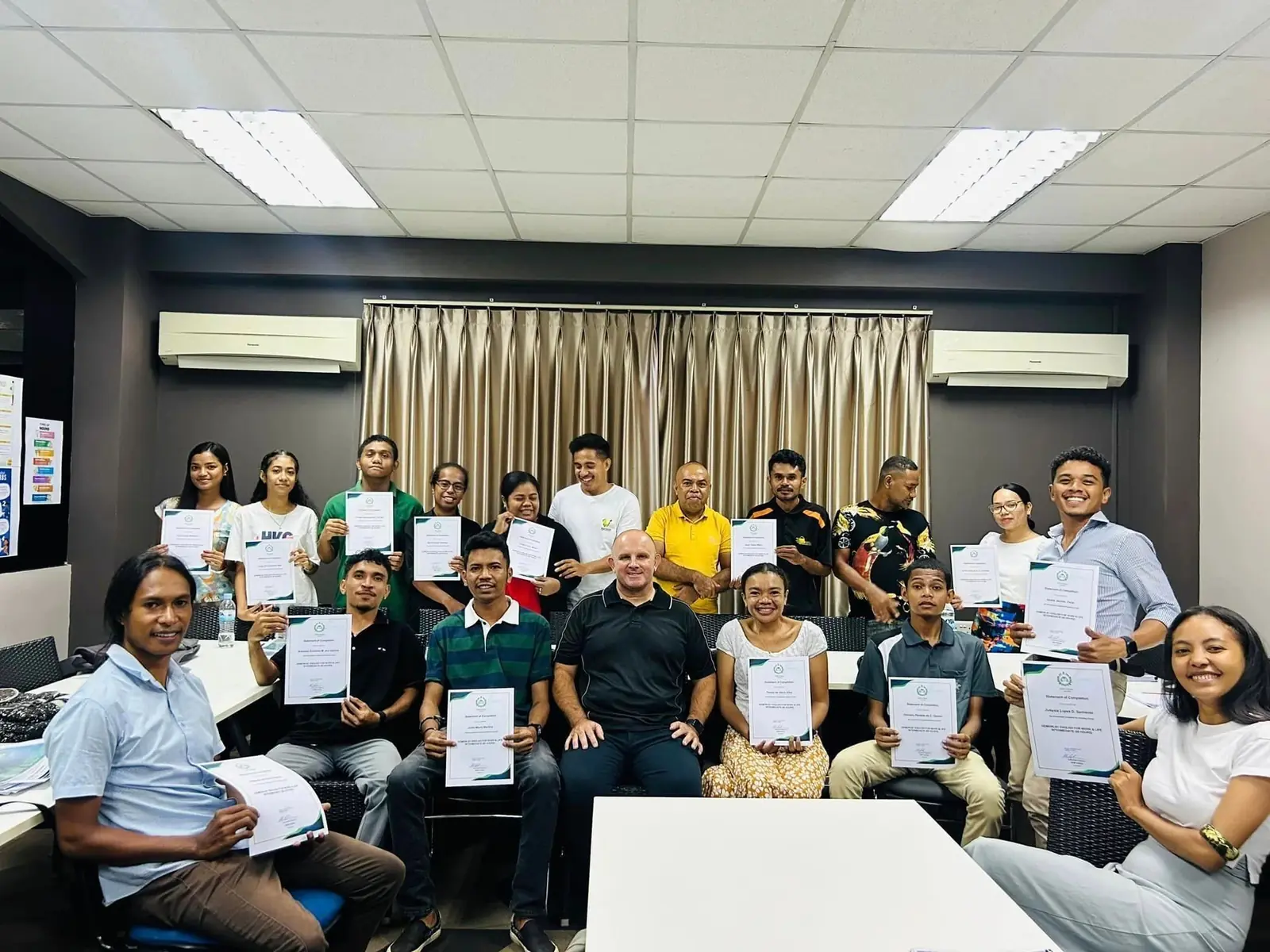
A class of graduates with their certificates, seated and standing in rows
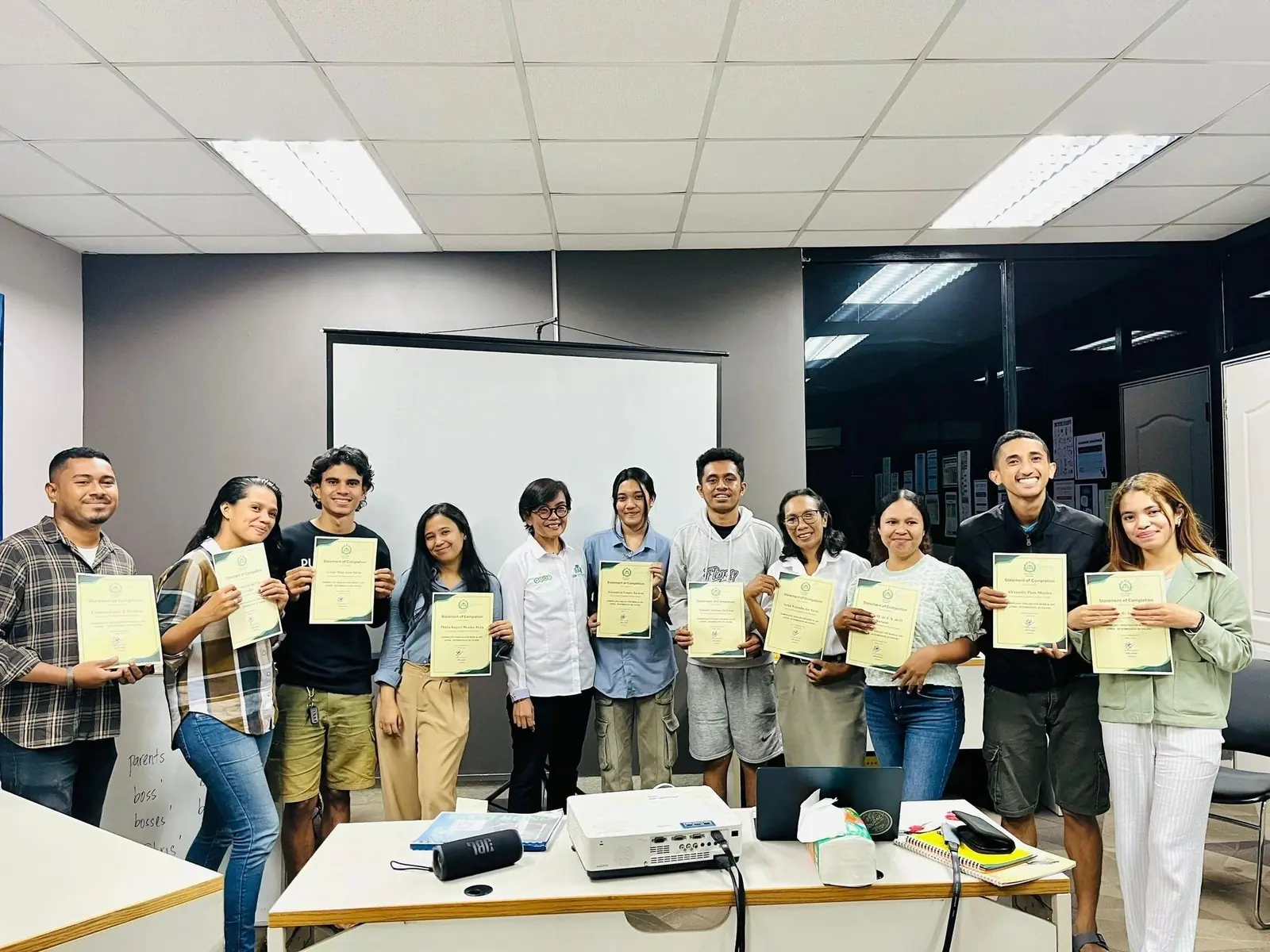
Graduates standing with their certificates in a classroom
Teacher leaning over to check an adult learner's work at a library table

Certificate I in English Proficiency

Basic English for short verbal exchanges, simple texts and everyday numbers and symbols.

Use basic English language skills to:

  • Participate in short basic verbal exchanges to communicate basic information on familiar topics.
  • Read and write short basic texts, including basic statements and questions.
  • Give and respond to short basic instructions.
  • Recognise and use numbers and common symbols for basic familiar purposes.
  • Build basic learning strategies.
  • Use ICT to support learning.
  • Build future goals and pathways.
Two young Asian adults talking face to face across a table with a tablet

Certificate II in English Proficiency + SP

Simple verbal exchanges, simple texts and digital tasks with developing learning strategies.

Use basic English language skills to:

  • Participate in short simple verbal exchanges.
  • Read and write simple texts.
  • Give and respond to simple procedures.
  • Use digital technologies to complete simple tasks.
  • Develop simple learning strategies.
  • Develop future goals and pathways.
Young Asian student standing at a flipchart presenting to seated classmates

Certificate III in English Proficiency + for Educators

Routine exchanges and texts, with effective communication for personal, social, educational and workplace purposes.

Use English language skills to:

  • Participate in routine verbal exchanges.
  • Read and write routine texts.
  • Give and respond to routine instructions.
  • Apply learning strategies.
  • Use digital technologies to complete routine tasks.
  • Communicate effectively for personal, social, educational and workplace purposes.
  • Establish goals and pathways.
Young Southeast Asian adults in a lively seminar discussion around a table with a laptop

Certificate IV in English Proficiency

Complex communication, complex written texts, research project planning and strategies for further study.

Use English language skills to:

  • Interpret and participate in complex communication.
  • Analyse and produce a range of complex written texts.
  • Apply learning strategies to a range of complex linguistic tasks.
  • Participate in research project planning and job-seeking activities.
  • Develop strategies for further study.

Book your place

Morning, afternoon and evening sessions are available at our Dili campus.